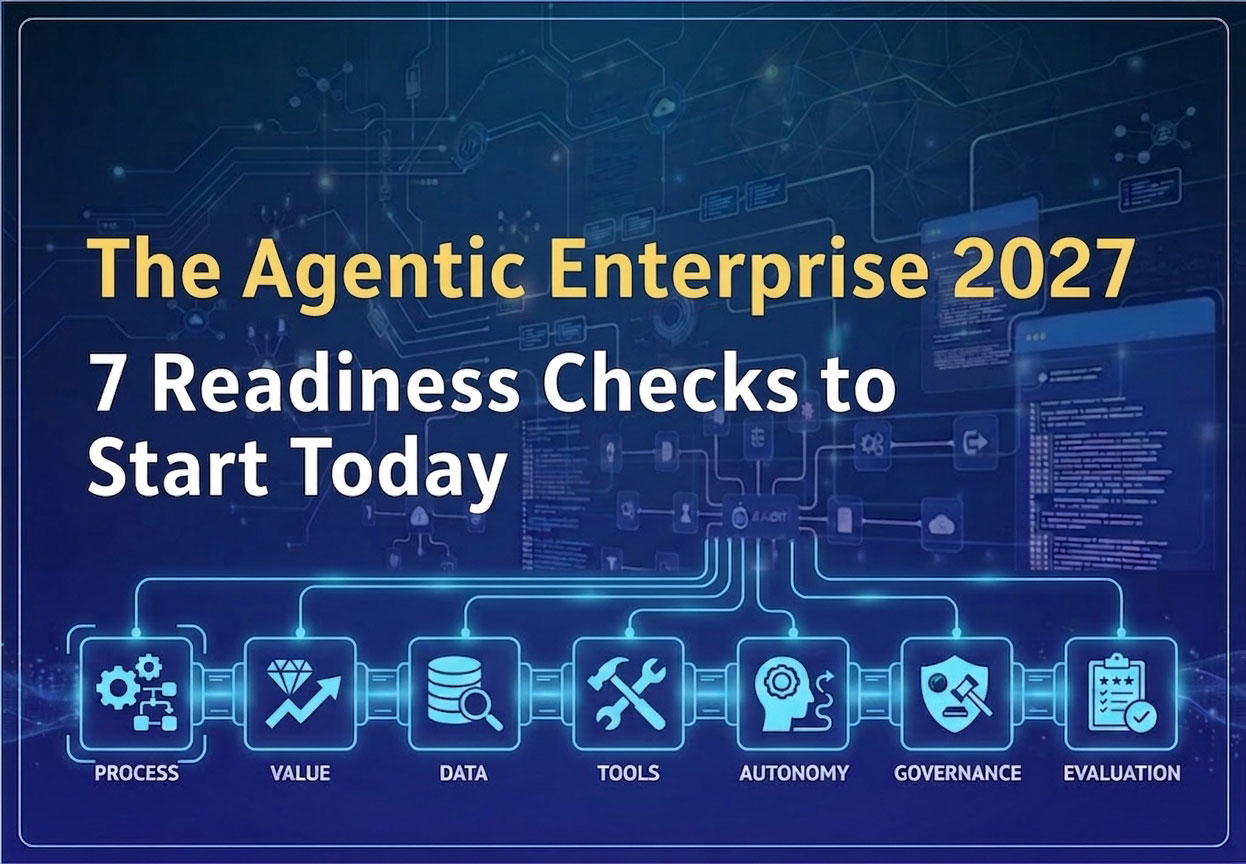
As AI Agents move from experimentation into business processes, OpenAI, Anthropic, Google and Microsoft are converging on the same conclusion: scaling Agentic AI depends not only on technology, but on organizational readiness : processes, data, systems, autonomy, governance and evaluation.
AI Agents are moving from POCs into business processes
Agentic AI is reaching a new stage. Companies are no longer only looking for assistants that can answer questions; they are beginning to integrate AI Agents that can interact with tools, data and business processes.
In its 2026 State of AI Agents Report, Anthropic states that 80% of surveyed organizations are already seeing measurable economic impact from their AI Agent investments. 57% use agents in multi-step workflows, while 81% plan to tackle more complex use cases in 2026.
- 80% — measurable economic impact
- 57% — multi-step workflows
- 81% — more complex use cases planned in 2026
But the main barriers are not limited to the models themselves: 46% cite integration with existing systems, 43% implementation costs and 42% data access and quality.
The key question for 2027 is therefore no longer only which AI Agent to build, but whether the organization is truly ready to integrate it into its operations.
Based on recommendations published by OpenAI, Anthropic, Google and Microsoft, seven readiness areas stand out.
1. Process : Do you know exactly what you want to entrust to the Agent?
Before choosing a model or technology, the first step is to fully understand the process to be transformed. A poorly defined process will not become more efficient simply because it is entrusted to AI.
Any workflow intended to become agentic should therefore be clearly mapped: Trigger → steps → decisions → data → systems → exceptions → human validation → expected outcome.
OpenAI particularly recommends AI Agents for processes involving complex decisions, multiple exceptions or unstructured data. For simple and deterministic processes, traditional automation may remain more relevant.
Key takeaway: a poorly controlled process does not become better simply because it is handed over to AI.
2. Business Value — Which KPI should the Agent actually improve?
“We deployed 10 AI Agents” is not a performance metric.
An agentic initiative should be tied from the start to measurable business outcomes:
- Processing time
- Cost per operation
- Error rate
- Resolution rate
- Productivity
- User satisfaction
- Revenue generated
The key question becomes: which metric do we want to improve, and what is its current baseline before AI is introduced?
3. Data — Does your Agent know where to find the right information?
An Agent connected to a CRM, ERP, document management system or knowledge base is only as effective as the data it relies on.
Organizations therefore need to define in advance:
- Which source is the source of truth?
- Who owns it?
- Which data is public, internal or confidential?
- What can the Agent read or modify?
- How is information kept up to date?
Key takeaway: data quality becomes a direct component of Agent quality.
4. Tools & Information Systems — Can your Agent actually interact with the enterprise?
One of the key differences between an AI assistant and an AI Agent is the ability to use tools and execute actions.
OpenAI distinguishes between tools used to access information and tools capable of performing actions in external systems.
CRM, ERP, APIs, document management systems, email, calendars and business applications can therefore become interaction points for the Agent.
For CIOs, this raises a new question: is the information system, historically designed for human users, also ready to accommodate AI Agent users?
5. Autonomy — How far should the Agent be allowed to act?
Not every use case requires the same level of autonomy.
- Level 1: Read
- Level 2: Recommend
- Level 3: Prepare an action
- Level 4: Execute after human approval
- Level 5: Execute automatically within predefined boundaries
Checking a customer file and issuing a refund clearly do not carry the same level of risk.
Key takeaway: autonomy should be defined action by action.
6. Governance & Security — Who controls the Agent?
The deeper an Agent connects to the information system, the more important governance becomes.
Google is advancing this approach through Agent Identity mechanisms that assign Agents their own identities and control their access to resources.
An organization should be able to clearly answer:
- Who is responsible for the Agent?
- Which data can it access?
- Which tools can it use?
- Which actions are prohibited?
- How are its actions logged?
- How can its permissions be revoked?
Key takeaway: an Agent that can act within the information system should be governed like an information system actor.
7. Evaluation & Human Handoff — How do you ensure the Agent remains reliable?
Anthropic places particular emphasis on evals, which are used to continuously measure Agent behavior.
Two dimensions are particularly important:
- Capability evals — what the Agent can reliably perform
- Regression evals — whether it continues to perform correctly after changes
An Agent in production should be tested against normal situations, but also missing data, exceptions, sensitive requests and out-of-scope cases.
And when it reaches its limits, handoff to a human should be designed into the workflow from the start.
AI Agent → Agent + Human → Human
Should you already move to multi-agent systems?
Not necessarily.
OpenAI recommends maximizing the capabilities of a single Agent before multiplying specialized Agents.
Start with one agent. Add tools. Measure. Split only when complexity requires it.
Multi-agent architecture should address a real architectural need, rather than becoming a technology goal in itself.
Agentic Enterprise 2027: are you Agentic-Ready?
Before launching new AI Agents, seven questions can serve as a readiness framework:
- 1. Process: Which process do we actually want to transform?
- 2. Business Value: Which KPI should improve?
- 3. Data: Are our sources reliable and governed?
- 4. Tools & Information Systems: Can our applications be used securely by an Agent?
- 5. Autonomy: What can it read, recommend or execute?
- 6. Governance: Who controls its access, limits and actions?
- 7. Evaluation: How do we measure reliability, and when should a human take over?
Toward an Agentic-Ready organization
The Agentic Enterprise of 2027 will probably not be the organization that has deployed the most AI Agents.
It will be the one that has prepared the right processes, the right data, the right integrations and the right level of governance to enable Agents to work effectively alongside humans.
At MEDIANET, this approach naturally extends our vision of digital transformation: start with the business need, structure the process and the information system, then integrate AI where it can create real and measurable value.
With Syrine.ai, MEDIANET’s first Augmented Digital Collaborator, this approach is also being tested on our own processes: start with a real use case, test, measure, learn, and progressively expand the Agent’s capabilities.
--------