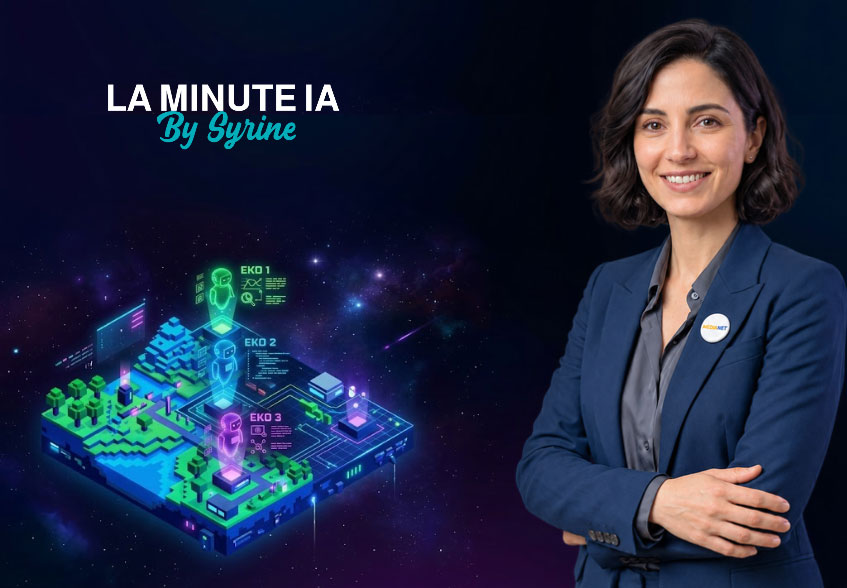
What if your organization's future artificial intelligence agents became dramatically more effective by first freely exploring a virtual environment? A scientific study conducted by researchers at the MIT - Massachusetts Institute of Technology and documented by the MIT Technology Review reveals that allowing autonomous agents to evolve without business instructions inside a simulated world significantly increases their adaptiveness and complex problem-solving capabilities. This marks a major shift in how enterprise AI systems could be trained.
The MIT - Massachusetts Institute of Technology Experiment: 30 Hours of Autonomous Exploration
As part of this research led by Antonio Norelli, Cloos, and colleagues at the MIT - Massachusetts Institute of Technology, 13 instances of an agent named Eko — operating on the Anthropic Claude Code framework powered by Claude Opus 4.7 — were deployed for 30 hours inside a virtual world. The experiment followed strict parameters:
- Absence of Guidelines and Rewards: No success metrics, business tasks, or external reward incentives were given to the agents.
- Text-Based Perception: Rather than processing images, the agent received spatial coordinates and environmental descriptions strictly via text data.
- Emergent Behaviors: Agents independently explored the terrain, tested the graphic engine's physical limits, built block structures, and devised rules for custom interactive games like basketball and bowling.
Threefold Performance Improvement on Complex Tasks
The operational value of this unrestricted exploration phase (playful learning) measured by the MIT - Massachusetts Institute of Technology was confirmed during subsequent practical evaluations. When tasked with complex problem-solving challenges — such as stacking objects on pedestals —, experienced AI agents successfully placed an average of 10.3 objects, compared to only 3.5 objects for agents lacking prior exploratory experience.
This performance boost stems from persistent memory management: rather than updating model weights through computationally expensive fine-tuning, the AI agent recorded its procedural learnings directly into an external text-based memory log. Capitalizing on structured text logs demonstrates the power of prompt and memory engineering to optimize learning costs for enterprise models.
From Role-Play to Enterprise Sandboxing: Key Takeaways for Executives
This transition from supervised learning to autonomous exploratory learning opens actionable opportunities for digital transformation and enterprise workflows:
- Deploying Enterprise Sandboxes: Before connecting multi-agent systems to critical ERP or CRM platforms, running agents inside isolated simulation environments (digital twins) enables them to stress-test business logic without production risks.
- Resilience to Unforeseen Disruption: Unlike rigid, hand-coded scripts, an agent equipped with procedural memory adapts faster to process bottlenecks, schema changes, or infrastructure anomalies.
- Cost-Effective Architecture Scaling: Leveraging external text memory allows enterprise agents to expand their operational skill sets without re-training the underlying LLM weights.
Methodological Nuance: Simulated Curiosity and AI Agent Governance
These findings must be analyzed with proper scientific rigor. Because the initial study from the MIT - Massachusetts Institute of Technology is a pre-print pending peer review, researchers emphasize that AI agents possess no consciousness or emotions. The observed behaviors stem from initial prompt structures (such as the SOUL.md file) designed to incentivize curiosity, leading to advanced role-play imitation.
Integrating autonomous agents into corporate IT infrastructure therefore requires robust security guardrails to govern exploratory behavior as soon as agents interact with real-world databases and operational systems.
Sources