AI and Productivity: How the Rivalry Between OpenAI (Dots) and Meta (Muse) Will Transform Work
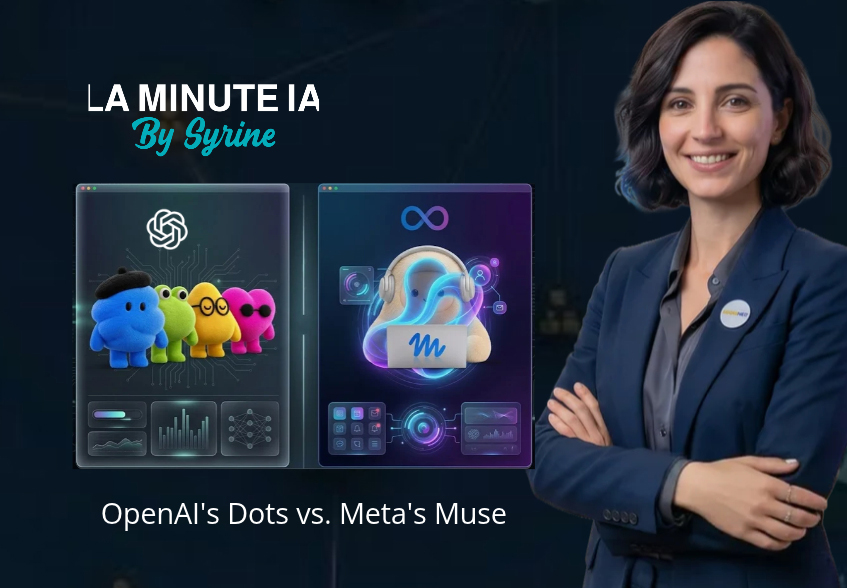
The announcement of Dots by OpenAI, directly competing with Meta's Muse, marks a fundamental shift in the history of generative artificial intelligence: the transition from passive chatbots to autonomous, proactive agents. This clash of giants redefines how users interact with virtual agents daily, while raising essential questions around data management and user experience personalization.
Strategic challenges:
The battle for memory and context: Until now, chatbots processed each conversation in near isolation. Dots and Muse introduce persistent contextual memory. The goal is to become the user's "daily operating system."
Ecosystem vs. Pure Experience: Meta holds a massive distribution advantage with its billions of users (WhatsApp, Instagram, Ray-Ban Meta smart glasses). OpenAI relies on the superiority of its reasoning models to establish itself as the professional and creative benchmark.
In the "Minute IA by Syrine" segment broadcast on Express FM on October 14, 2026, Wassim Ben Larbi and Syrine discussed this major news story as part of their daily program. Following this on-air conversation, MEDIANET delves deeper into the topic and analyzes the strategic implications of this development..
What is Dots, OpenAI's new weapon for productivity?
Designed to go beyond simple instant-query interactions, Dots operates as an always-on agent. Equipped with its own secure execution environment and connected to the ChatGPT ecosystem, it manages complex tasks in the background without requiring continuous human intervention.
Dedicated environment: Each agent runs on its own cloud virtual machine to execute tasks autonomously.
Extensive interconnection: Seamless integration with thousands of business applications and collaborative tools.
Proactive execution: Ability to monitor information flows and prepare autonomous actions.
Meta's Muse: The multimodal ecosystem serving individuals and SMBs
Facing OpenAI, Meta deploys Muse by leveraging its presence at the core of daily life and local commerce. Muse relies on a secure infrastructure and integrates directly into the company's social and hardware platforms.
Embedded in daily routines: Natural usage within instant messaging platforms and wearable devices.
Small business-oriented: Automation of customer interactions, bookings, and operational tasks.
Enhanced security: Strict isolation system preventing any critical action without explicit validation.
What are the impacts for businesses?
The simultaneous arrival of these autonomous agents profoundly transforms the IT landscape and requires CIOs and tech professionals to re-evaluate their infrastructure.
Evolution of software architectures and UX
The era where users manually navigated between multiple software applications is coming to an end. IT applications must adapt to become consumable connectors for autonomous agents.
API standardization: Software vendors must design programmable interfaces optimized for AI reading and execution.
Access governance: Granular permission management to ensure agents operate under strictly controlled access levels.
Security and prompt injection: Stronger protection against instruction manipulation within the data processed by agents.