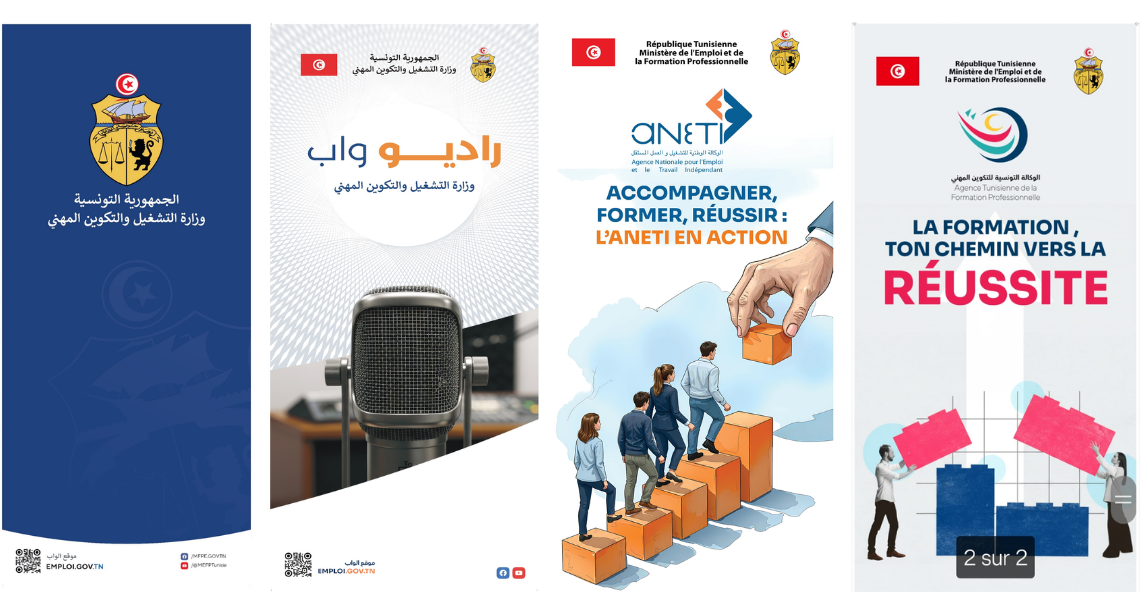
From a 360° communication strategy to the creation of a pioneering web radio studio
How to modernize the communication of a public institution, harmonize the image of several national and regional structures, bring public services closer to their beneficiaries, and make teams autonomous in content production?
This is the challenge met by MEDIANET with the Ministry of Employment and Vocational Training, within the framework of the Vocational Training and Integration Support Program – PAFIP, implemented in cooperation with the French Development Agency.
More than a communication mission, the project represented a genuine institutional transformation: a new strategy, a unified visual identity, awareness-raising content, equipment, training, and the creation of an audiovisual production and web radio studio.
Project at a glance:
- Beneficiary institution: Ministry of Employment and Vocational Training and supervised entities
- Program: Vocational Training and Integration Support Program – PAFIP
- Financial partner: French Development Agency
- Sector: E-government, employment, and vocational training
- Expertise mobilized: strategic consulting, institutional communication, branding, content production, audiovisual, training, and equipment
- Scope: central structures, regional directorates, and supervised bodies
- MEDIANET intervention: design, deployment, and operational support
What is the PAFIP program?
PAFIP is a structuring program designed to strengthen the efficiency of the Tunisian vocational training system, the capacities of its actors, and its alignment with economic and territorial needs.
The program specifically supports training centers, institutional entities, and national and regional stakeholders, with the goal of improving employability and professional integration for young people.
Within this framework, a strategic focus was dedicated to modernizing the communication of the ministry and its supervised structures.
The ambition was twofold:
- Improve the flow of information within the institution;
- Make the ministry’s services, programs, and messages more accessible to their beneficiaries.
The challenge: unifying without standardizing
Public institution communication must meet several requirements simultaneously.
It must maintain state credibility while adopting more accessible formats. It must ensure national consistency while accounting for regional realities. It must also inform highly diverse audiences: job seekers, youth, businesses, social partners, training stakeholders, and institutional partners.
The diagnostic conducted by MEDIANET highlighted several priority needs:
- Strengthen coordination between central and regional structures;
- Harmonize identities and communication materials;
- Improve the visibility of services offered to citizens;
- Produce more awareness-raising content;
- Professionalize digital and audiovisual communication;
- Equip teams with sustainable skills and tools
The stake was therefore not merely to produce new media materials. It was to build a coherent, operational, and sustainable institutional communication system.
An approach based on listening and co-construction
The mission began with an in-depth audit of internal and external communication.
MEDIANET conducted interviews with nearly twenty central and regional directors and managers. Existing practices, information distribution channels, team needs, and media formats used were analyzed.
This listening phase made it possible to build a strategy rooted in field realities, rather than a standardized response.
<h2 class="